Troubleshooting Guides
P&B Heating & Air Conditioning Corp.
Fujitsu Mini-Split Homeowner Troubleshooting Guide
Congratulations on purchasing a Fujitsu mini split system. Fujitsu has been a leader in the field of mini spit units for decades, and some of the most efficient units in the industry.
Below are some homeowner tips for you to follow when you are having issues with your system:
Look on the bottom right-hand side of all wall mounted indoor units. There you will find three lights Operation, Economy, and Timer. In normal operation the lights will be solid.
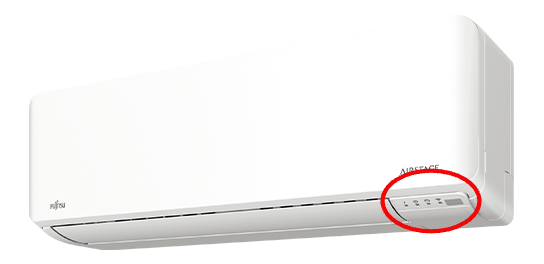
If the unit fails to operate, these lights will blink in a pattern. There are several different blink codes, and each one will indicate a different issue with the unit.
The first thing homeowners should do when they have a “blink code”, is to reset the unit.
The unit will not reset by itself so you will need to turn off the power at the circuit breaker.
The blink code can be triggered by a power surge. Turning off the remote will not reset the code.
Leave the breaker off for at least 15 minutes. Then turn the breaker back on and turn on the unit. It should clear the code and work properly.
If the code comes back (Usually within 10 minutes or less) then there is an issue with the unit, and a service tech will need to assess the system.
If you have a multizone system ( one outdoor unit and 2 or more indoor units) All the indoor units MUST be in the same mode. (Cool, Heat, Fan, or Dry) If the units are in different modes the system will not operate and you will get an error code usually a single blinking Green light.
Once you put all the units in the same mode the units should return to normal operation, if not try to reset the breaker.
Other issues that can cause the unit to go into a blink code is a blockage of the outdoor fan. Such as a buildup of snow, ice or debris. If the fan motor has any resistance when it starts to turn the unit senses this and shuts down the unit to protect the motor from damage.
Do not dump hot water on the unit to melt the ice or stick anything inside the unit to try and clear any obstruction. This can cause damage to the unit and void the warranty.
It is also very important not to open the service door and try to repair the unit yourself. The unit is powered with DC current and needs to be discharged properly before servicing. This is very dangerous and needs to handled by a trained technician!
Filter Maintenance
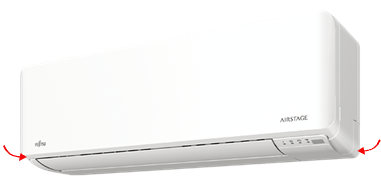
Wall mounted units all have two filters that need to be maintained. Grasp both sides of the access door and pull up gently but firmly.
The filters can be removed by pulling them forward and down.
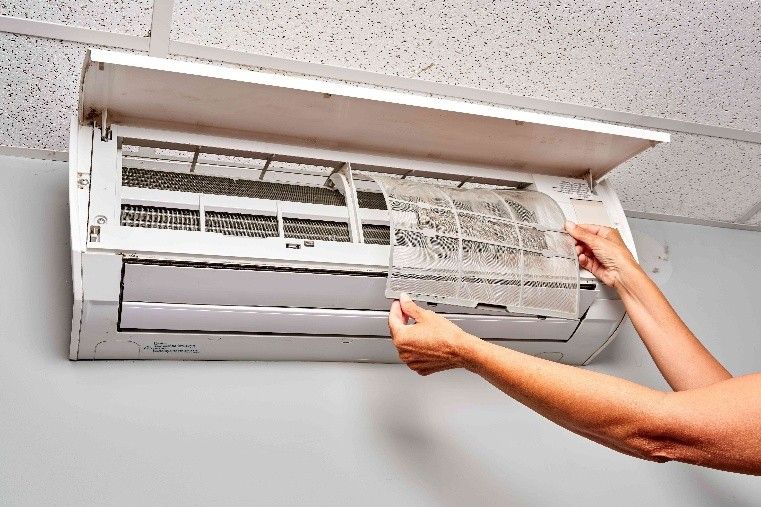
Wash them in a sink with warm water but DO NOT USE ANY SOAP OR DETERGENTS. Be sure to let the filters dry completely before reinstalling. If you put wet filter in, they will drip and could cause an airflow restriction and cause the unit to ice up in cooling mode or go into a fault.
DO NOT PUT THE FILTERS IN THE DISHWASHER. The hot water will damage them, and it will need to be replaced.
Multizone units
Some Systems are known as a ”Multi zone unit”. This is when you have One outdoor unit connected to two or more indoor units.
When using a multizone system it is important that all the indoor units are in the same Mode (Cool, Heat, Dry, or Fan) A common mistake is having the units in different modes. This will cause the system to go into a fault mode. If this happens follow the steps below.
- Even with the light blinking change all indoor units to the same mode
- Turn off the breaker and wait at 5 - 10 minutes.
- Reset breaker. The unit should then run properly.
If the fault code comes back, call to schedule a service appointment.
Deep Clean
Mini split units can have a mold build up. For this reason, we recommend that indoor units have a thorough deep clean every 3-5 years to keep the units running efficiently.
Wall mounted control
If your unit has a wall mounted control, error codes will be displayed on the control panel. The first thing to do is reset the unit like the instructions above. If the code comes back, call for service.

❄️ Central Air Conditioning Homeowner Guide
Before scheduling an AC repair, try these troubleshooting steps to see if the system resets:
Check your filter. A clogged, dirty filter starves the A/C system and can cause it to freeze up. Check your filter monthly and replace it if it looks gray or dusty. The filter can never be “Too clean” when in doubt, replace the filter.
Check for Ice Restrictions: Look at the copper lines running into your outdoor unit and the indoor coil. If you see a buildup of ice or frost, your system is restricted. Turn the thermostat completely OFF and switch the fan setting to ON to let it thaw, for at least 4 hours then check your air filter.
Even if the Ice outside melts, the unit for the inside may still be frozen
The 15-Minute Breaker Reset: If your outdoor condenser stops running after a storm or a
local power dip, it may just need a hard reset. Flip your AC circuit breaker to the off
position for 15 minutes, then flip it back on to clear the system's fault memory.
Clear the Outdoor Condenser: Debris, leaves, and grass clippings can clog the metal
fins of your outdoor unit, causing it to overheat and shut down. Keep plants trimmed back
at least 2 feet. You can gently rinse the outside fins with a garden hose, but never use a
pressure washer, as it will bend the delicate aluminum fins.
DO NOT REMOVE THE COVER OR THE ACCESS PANEL. SERIOUS INJURY OR DEATH CAN OCCUR. PLEASE LEVE IT TO A CERTIFIED TECHNICIAN. NO MATTER WHAT CHAT GPT SAYS!!
Check the Condensate Safety Switch: If your AC suddenly cuts off entirely on a hot day,
Check the emergency pan to see if it is full of water. If the drain line clogs, a
Safety float switch will trip to completely shut down the system and prevent water from
ruining your ceilings. You can use a shop vac and vacuum out the water to temporarily restore cooling until a technician can clear the drain.
If your indoor unit is in the basement or a crawl space the unit may have a condensate pump that also is equipped with a safety switch. Be sure the pump is plugged in and has power.
⚠️ SAFETY WARNING: Like our mini-splits, central AC units store high-voltage electricity in
capacitors that can shock you even when the breaker is off. Never open the electrical panel
on the outdoor unit or try to force the fan blades to turn with an object if they are stuck.
💧 P&B Hydronic Heating Coil Homeowner Guide
For customers with hydronic heating systems. Troubleshooting can be a little more challenging, and knowing if the issue is with the Air handler or the boiler, and trying to know if you need a plumber or an HVAC tech. below are some guidelines to help you.
If your air handler is blowing air but the house isn't getting warm, the issue is most likely with the boiler, and you would need a plumber
- Verify Your Boiler is Running: Hydronic heating coils rely entirely on the hot water produced by your boiler. Check that your main boiler system is turned on, and is actively firing up.
Check for Trapped Air: A common issue with hydronic systems is an air pocket getting trapped inside the coil, which blocks the hot water from circulating. If you feel the copper pipes leading into your air handler and one is hot but the other is completely cold, air may be trapped. If this is the case, the system will need to be bled out. We recommend calling a licensed plumber. Warning the chance of scalding water can cause serious injury.
You may have a faulty Circulator, Zone valve, flow valve or relay. This would have to be determined by a licensed plumber.
- Mode Synchronization: your air handler splits duties between winter heating (via the boiler) and summer cooling (via an outdoor AC condenser), make sure your thermostat is properly switched over to HEAT and the fan is set to AUTO.
- Airflow Check: Clean air filters are just as important for hydronic coils as they are for regular furnaces. A blocked filter slows down the airflow, meaning the system can't pull the heat off the hot copper coils effectively.
- If the fan is not running; Check to see if the fan is in the “Auto” or “On” mode. It should be in “Auto”.
Then turn the fan to the “On” position and see if the fan comes on. If it does check to see if the air is blowing warm or cold.
If the Air is warm Call the HVAC company if it is cold call the plumber.
- ⚠️ SAFETY WARNING: Hydronic coils circulate water at incredibly high temperatures and pressures. Do not attempt to solder pipes, tighten fittings, or dismantle the air handler casing if you notice a leak. If you see water pooling around the unit, turn off the water supply and call for service immediately.
🔥 Forced Hot Air Gas Furnace Homeowner Troubleshooting Guide
Below are some homeowner tips to follow when you are having issues with your Gas fired furnace system:
1) Check the Thermostat Mode: Ensure your thermostat is set to the HEAT mode, and the temperature is set higher than the current room temperature. If the screen is blank, try replacing the batteries.
If you have a Wi-Fi-enabled thermostat and the screen is blank, that means there is no power to the thermostat and may be no power to the unit. See below.
2) Inspect the Furnace Power Switch: Check the switch on or near the side of your indoor furnace unit (it often looks like a standard light switch). If your furnace is in the basement or a crawl space, in many homes there will be a switch at the top of the basement stairs or at the entrance to the crawl space. Sometimes it can be confused with a light switch and it can be accidentally flipped off.
3) The 15-Minute Breaker Reset: Just like a mini-split, a sudden power surge can lock up a furnace's control board. Turn off the power at your circuit breaker, leave it off for 15 minutes, then turn it back on. Then turn the system back on at the thermostat, to see if this will bring the unit back online.
4). Most units have a door switch that will turn the system off when removed and it will eliminate the error code. Be sure the doors are properly secured to the unit
5) Look for Flashing LED Error Codes: If the furnace still will not come back on then Most modern furnaces have a small, clear sight glass on the lower door panel. If the system fails to run, you will see a flashing light
pattern. Note the number of blinks before calling us! DO NOT REMOVE THE DOOR PANELS!!
6) Filter Maintenance: A clogged, dirty filter starves the furnace of air, causing it to overheat and trip its safety switches. Check your filter monthly and replace it if it looks gray or dusty.
⚠️ SAFETY WARNING: Never attempt to open the main burner door or adjust the gas
valves yourself. Gas furnaces require specialized tools to check for carbon monoxide and
gas leaks. If you ever smell gas, leave the house immediately and call us or your gas utility
company.